Cayambe-Coca Reserve
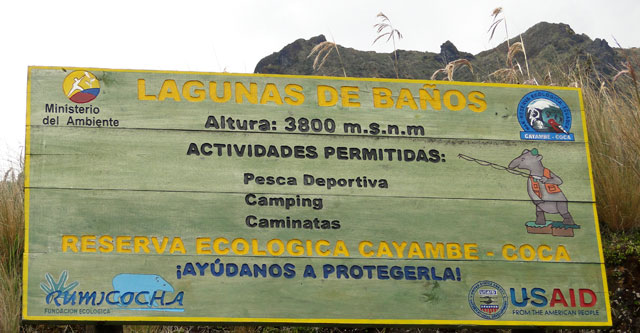
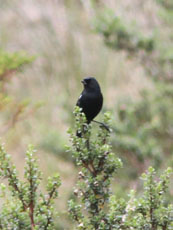
The Cayambe-Coca Reserve can be accessed near the Papallacta hot springs (Termas de Papallacta). There is a restricted access road behind the hot springs spa where a guard monitors the private entrance to the reserve. This entrance begins with farmland that belongs to the spa and then enters and areas of elfin forest where the giant conebill has been reported. Further uphill you will find the park registration office that has some maps of the trails. If you do not have a special permit you cannot continue by car any further. The main road to the north reaches one of the water intake lakes and continues to Oyacatchi. Just after the park offices there is a road to the left (west) that leads to a network of lakes and further trails that end-up at the other entrance by the papallacta pass antenna. If you are an avid trekker then you can begin at the antenna and descend (4 to 6 hours) to the Papallacta entrance.
This is an extensive reserve of 403,000 hectares surrounded by the provinces of Pichincha to the east, Imbabura to the north east, Sucumdbios to the northwest, and Napo to the Southwest. Most of the reserve is not easily accessible since the southwest portion of it provides drinking water to the city of Quito. There is an access road that crosses north-to-south but it is required to obtain permits in advance from the ministry of ambient. This road can be accessed near the town of Cayambe at the small town of Oyacachi, crosses the reserve to the south and exits at the Papallacta Spa. It can be traveled in one day about 4 hours drive, of course if you plant to bird this road you would need two days and would require camping above 3500 meters.
Tel: (593) 0999466636 - 0991914333 mail: 
Phone:
593-999466636
593-991914333
Mail:
Copyright © 2006 - 2016 Pululahua Hostal





West Slope Tours:
Yanachocha Reserve
Pululahua Geobotanical Reserve
Refugio Paz de las Aves
Oil Bird Cave
23 de Junio
Yellow House
Maquipucuna Cloud Forest
Mindo Nambillo Reserve
Santa Lucia Cloud Forest
EcoRuta o Paseo del Quinde
Mirador Rio Blanco
Septimo Paraiso Cloud Forest
Mindo Loma Cloud Forest
Pachijal Reserve
Sachatamia Rain Forest
Milpe Bird Sanctuary
Bellavista Cloud Forest
San Tadeo
Western Lowlands
Mangaloma Reserve
Rio Silanche Bird Sanctuary
Mashpi Reserve
Bilsa Research Station
Rio Canade Reserve
Botrosa Road
East Slope Tours
Papallacta Pass
Cayambe Coca Reserve
Guango Lodge
Cabañas San Isidro
Hosteria Hacienda Cumanda
Guacamayo Cordillera
WildSumaco
Northern Amazon Tours:
Jatun Sacha
Garenolodge
Laguna Paikawe
Southern Ecuador:
Cordillera del Condor & Marañon Region
Cabañas Copalinga
Podocarpus National Park
Cabañas Yankuam
Tapichalaca Reserve
El Cajas
Southwestern Ecuador: Tubmesian & Aquatic Birds
Rio Palenque
Isla de la Plata
Rio Ayampe
Machalilla National Park- Aguas Blancas
Isla Corazon
Segua Marsh
Lalo Loor Reserve
Juananu Marsh
Cojimies Mangroves
Mache-Chindul Reserve
GALAPAGOS ISLANDS TOURS
Land Tour & Darwin’s Finches
Northern Highland Sites
Antisana Reserve
Papallacta Pass Antenas
Cayambe-Coca Reserve
Bosque Jerusalen
Condor Park
Cuicocha Lake
San Pablo Lake